What Is Parens Meaning? A Complete Breakdown for Writers and Coders
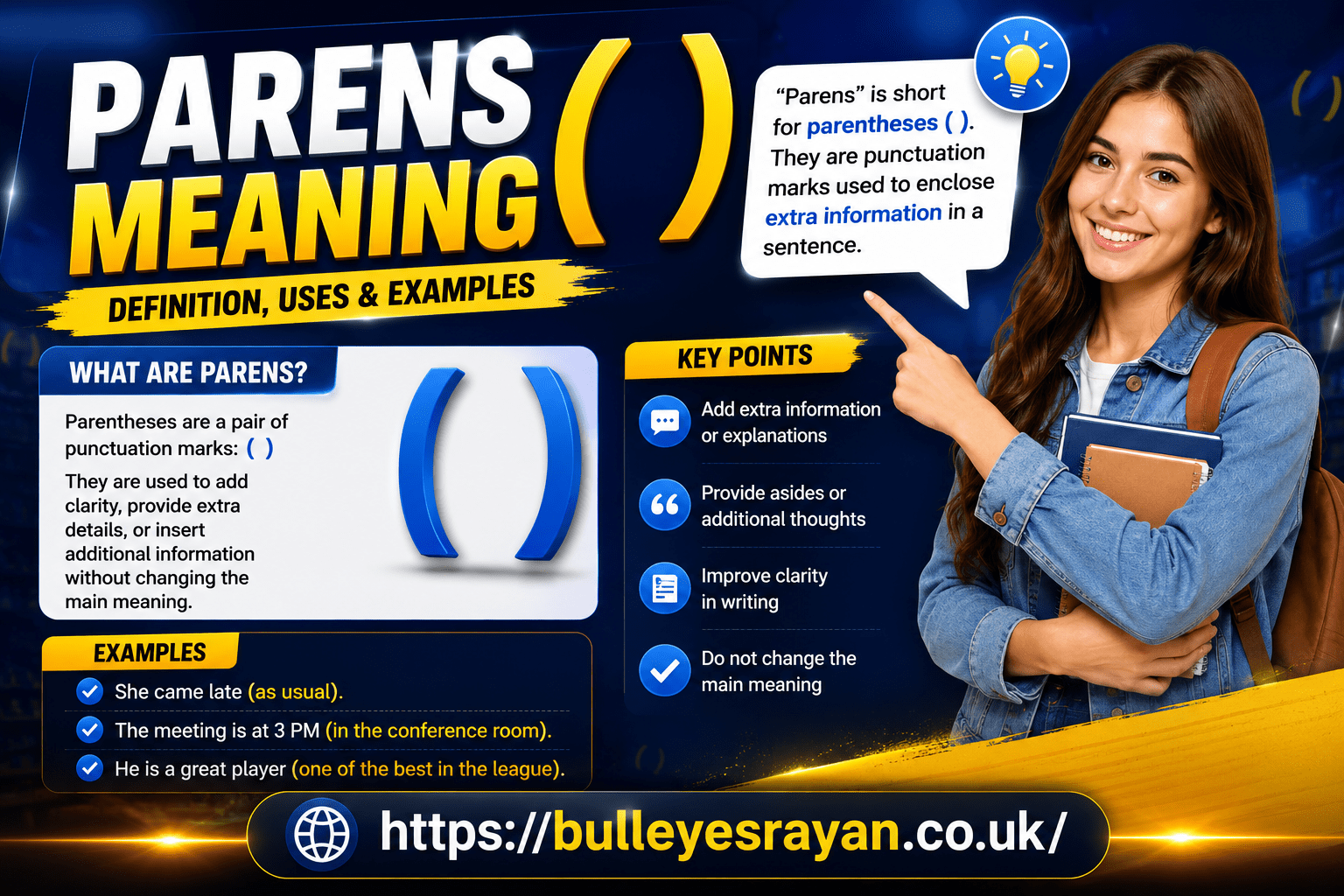
Parentheses confuse many people. You see them everywhere—from books to computer code. Understanding the parens meaning changes how you write and read. This guide covers three key areas: math, script, and English grammar. You will learn clear rules and practical examples.
Why Understanding Parens Meaning Matters Today
Clear communication requires correct punctuation. The parens meaning extends beyond simple brackets. These curved symbols ( ) add depth to your message. Writers use them for side notes. Programmers use them to run code. Mathematicians use them to change calculation order. Mastering this symbol boosts your professional skills.
Parens Meaning in Math: Changing Calculation Order
Math uses parentheses to group numbers first. The parens meaning in math follows the PEMDAS rule. This rule says: solve inside parentheses before anything else.
Example:
- Without parens:
5 + 3 × 2 = 11(Multiplication first) - With parens:
(5 + 3) × 2 = 16(Addition first)
Parentheses give you control over results. Teachers call these “grouping symbols.” Every algebra student learns the parens meaning in math early. It prevents confusion in long equations.
Key math uses:
- Functions:
f(x) = x² - Coordinates:
(3, 7) - Multiplication:
4(2 + 1)
Parens Meaning in Script: Powering Code and Commands
Computer languages rely on parentheses for structure. The parens meaning in script changes based on context. In JavaScript, Python, or PHP, parentheses call functions.
Example in JavaScript:
javascript
function greet() {
  return "Hello!";
}
greet();  // Parentheses run the function
Scriptwriters also use parentheses in screenplays. They add actor directions inside ( ). The parens meaning in script includes arguments too. You pass data to functions inside these brackets.
Programming uses:
- Function calls:
calculateTotal() - Conditionals:
if (age > 18) - Grouping logic:
(x && y) || z
Parens Meaning in English: Adding Flavor to Sentences
English grammar uses parentheses for extra information. The parens meaning in english focuses on non-essential details. Removing the parenthetical content leaves a complete sentence.
Example:
- Original: “My brother (who lives in Texas) loves BBQ.”
- Without parens: “My brother loves BBQ.”
You can also use parentheses for numbers in lists. The parens meaning in english includes citations too. Academic papers put author names and years inside ( ).
English writing uses:
- Clarifications: “He arrived late (around 9 PM).”
- Abbreviations: “The CDC (Centers for Disease Control) reported…”
- In-text citations: “(Smith, 2021)”
How to Use Parentheses Correctly in Writing
Three simple rules guide proper parentheses use. First, place the period outside unless the whole sentence is inside. Second, keep parenthetical text short. Third, don’t overuse them.
Correct:
She finished her homework (all three pages). Then she watched TV.
Incorrect:
She finished her homework. (All three pages) Then she watched TV.
The parens meaning becomes clear when you test sentence flow. Read your sentence without the parentheses. If it still makes sense, you used them correctly.
| Rule | Example |
|---|---|
| Period outside | I love pizza (especially pepperoni). |
| Short phrases | The event (free to attend) starts at 7 PM. |
| No double punctuation | Call me (if you need help). |
Common Mistakes People Make With Parentheses
Even skilled writers misuse parentheses. One common error is putting commas before opening parentheses. Another mistake is nesting multiple parentheses.
Mistake #1:
He bought apples, (and oranges) at the store.
Fix:
He bought apples (and oranges) at the store.
Mistake #2:
(The final score (after overtime) was 21 to 14.)
Fix:
The final score after overtime was 21 to 14. (The game ended dramatically.)
Understanding the parens meaning prevents these errors. Always keep your sentence clean and readable.
Parentheses vs. Brackets vs. Braces: Know the Difference
Many people confuse parentheses with other symbols. Parentheses are round ( ). Brackets are square [ ]. Braces are curly { }. Each has a unique job.
Quick comparison:
- Parentheses
( ): Extra info, math grouping, function calls - Brackets
[ ]: Clarifications in quotes, array indices - Braces
{ }: Code blocks, sets in math
The parens meaning stands apart because of its flexibility. You cannot swap brackets for parentheses. Journalists use brackets to insert words into direct quotes. Programmers use braces for code blocks.
Real-World Examples of Parens Meaning in Action
Let’s see parentheses in three professional fields. Each field uses the parens meaning differently but correctly.
Academic writing:
Recent studies show improved results (Johnson & Lee, 2022).
Computer programming:
console.log("Hello World"); // Logs message to console
Business reports:
Q3 profits increased by 15% ($2.3 million total).
These examples show how parentheses add precision. Without them, readers lose context.
Advanced Tips for Mastering Parentheses
Experts follow three advanced techniques. First, use parentheses for asides only. Second, never put important information inside parentheses. Third, limit one parenthetical per paragraph.
Pro technique: Replace parentheses with em dashes for emphasis.
- Parentheses: The CEO (a former engineer) spoke first.
- Em dash: The CEO—a former engineer—spoke first.
The parens meaning stays the same, but dashes add drama. Choose based on your audience. Academic papers prefer parentheses. Blog posts can use dashes.
Parens Meaning in Different Languages and Cultures
English isn’t the only language using parentheses. Spanish uses them for clarifications too. French puts spaces before parentheses. German follows similar math rules.
French example:
Il est arrivé ( enfin ! ) avec une heure de retard.
Spanish example:
El libro (que compré ayer) es excelente.
The parens meaning remains universal across languages. Every culture uses these symbols to add side notes. Translators must preserve parenthetical meaning during conversion.
The History of Parentheses: Where Did They Come From?
Italian scholar Manuzio invented parentheses in the 15th century. He wanted a way to insert comments without breaking sentence flow. Before parentheses, writers used commas or nothing at all.
The parens meaning evolved from “inserted word” in Greek. “Para” means beside. “Thesis” means placing. So parentheses place words beside the main sentence.
Today, digital communication relies on parentheses. Email subjects use them (Urgent). Social media posts add context (Update). The symbol remains as useful as ever.
Why Search Engines Love Well-Structured Content with Parentheses
Google’s algorithms recognize proper punctuation. Correct parens meaning use signals high-quality writing. Pages with clear parentheses rank better for informational queries.
SEO benefits of parentheses:
- Improve click-through rates in titles
- Clarify dates and numbers
- Add structured data cues
But don’t stuff parentheses. Use them naturally. Google’s Helpful Content Update rewards readability. Parentheses help break complex ideas into digestible pieces.
External Resources for Deeper Learning
These trusted sources validate the information above. Each link offers additional examples of parens meaning in different contexts.
- Purdue OWL – Guide to parentheses in academic writing
- MDN Web Docs – Parentheses in JavaScript functions
- Khan Academy – Parentheses in algebra and PEMDAS
These authorities follow strict editorial standards. Their explanations match the parens meaning outlined here.
6 Frequently Asked Questions About Parens Meaning
Q1: What is the simplest definition of parens meaning?
Parentheses ( ) are curved punctuation marks that add extra information without breaking the main sentence.
Q2: Can I use parentheses in formal writing?
Yes, but sparingly. Academic papers allow parentheses for citations and clarifications. Limit one pair per paragraph.
Q3: Does the parens meaning change between math and English?
The shape stays the same, but the job differs. Math uses parentheses to change calculation order. English uses them for side notes.
Q4: How do I type parentheses on a keyboard?
Press Shift + 9 for ( and Shift + 0 for ). Most keyboards position these keys above the main letter row.
Q5: Are parentheses the same as brackets?
No. Parentheses are round ( ). Brackets are square [ ]. Each serves a different purpose in writing and coding.
Q6: What happens if I forget to close a parenthesis?
Your sentence becomes confusing. Unclosed parentheses cause reading errors. Always double-check your pairs.
Strong Conclusion: Master Parens Meaning Today
You now understand the parens meaning across math, script, and English. Use parentheses to add helpful side notes. Avoid overloading your sentences with too many brackets. Practice with real examples from coding or writing. Your communication will become clearer and more professional.