Opta Stats: The Only Match Truth You Need
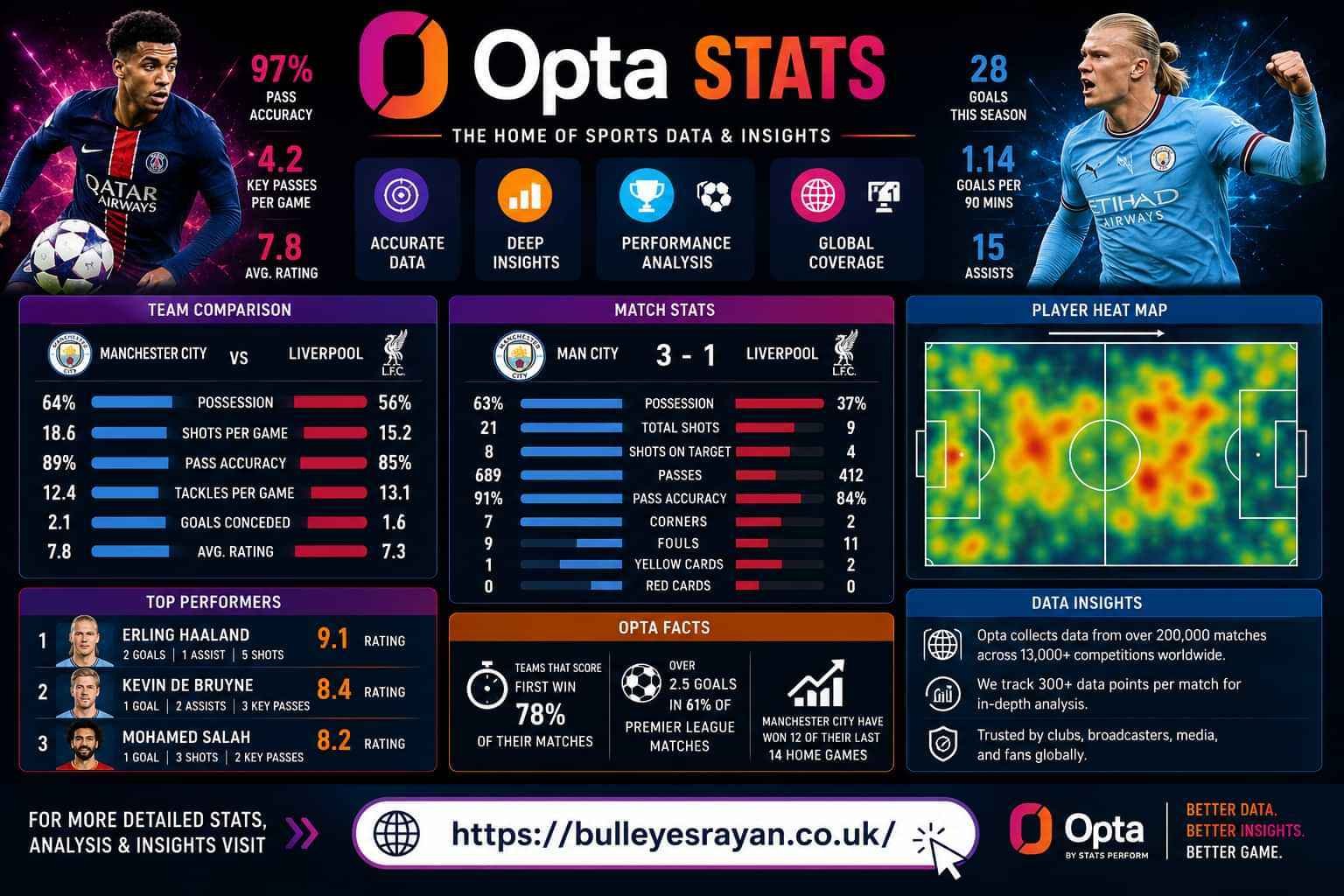
Numbers do not lie. In modern football, opinions fade, but opta stats remain. Coaches use them. Bettors trust them. Analysts breathe them. This guide unpacks how opta stats turn raw match data into winning decisions. You will learn to read possession with purpose, interpret shots with context, and predict outcomes with clarity.
What Makes Opta Stats Different from Basic Match Data
Basic match data tells you who scored. Opta stats tell you how. The difference lies in event tracking. Every pass, tackle, and sprint gets tagged with time, location, and outcome. While standard scoreboards show results, opta stats reveal performance. You see possession quality, not just quantity. You measure pressure, not just shots.
Opta stats use a live data feed that updates within seconds. This speed changes everything. A manager adjusts formation based on live opta stats. A fantasy player transfers a striker whose expected goals (xG) stays high despite one bad miss.
Real-Time Decision Power
- In-game adjustments: Substitutions based on fatigue metrics.
- Risk assessment: Yellow card probability per player.
- Momentum shifts: Territory gains after tactical changes.
How Opta Live Stats Change Match Viewing
Watching a match without opta live stats is like driving without a dashboard. You see the road but miss the engine data. Opta live stats overlay real-time metrics: passing accuracy, defensive line height, and attacking speed. These numbers arrive before the next commercial break.
For example, a team holds 70% possession. Basic viewers call it control. Opta live stats show 60% of those passes happen in their own half. That changes the story. Possession becomes protection, not pressure. Live data strips away illusion.
Three Live Metrics That Matter Most
- Field Tilt: Percentage of final-third passes. Anything above 65% signals genuine danger.
- PPDA (Passes Allowed Per Defensive Action): Low PPDA (under 10) means intense pressing.
- Expected Threat (xT): Measures pass progression toward goal.
These opta live stats separate casual fans from sharp analysts.
Reading Opta Player Stats for Smarter Scouting
Clubs spend millions on transfers. The best ones rely on opta player stats before signing a contract. Goals and assists hide flaws. A striker scores 15 goals but misses 50 big chances. That unsustainability appears only in opta player stats.
Consider two midfielders with similar pass completion (88%). Player A attempts 30 short backward passes per game. Player B attempts 15 forward progressive passes. Opta player stats highlight Player B’s higher risk-reward value. Scouting without this depth misses gold.
Player Stats Table: The Full Picture
| Metric | What It Reveals | Why It Matters |
|---|---|---|
| Goals minus xG | Finishing luck vs skill | Predicts goal-scoring regression |
| Progressive carries | Dribbles toward opponent goal | Creates numerical advantages |
| Tackles won (final third) | High-press effectiveness | Direct shot creation potential |
| Succ. pressure % | % of pressures winning ball | Defensive transition speed |
| Shot creation actions | Key passes + dribbles + fouls won | Playmaking volume |
| Aerial duel win rate | Physical dominance in air | Set-piece value |
Use opta player stats to find undervalued talent. A fullback with high progressive carries but zero assists is a breakout candidate. The data signals opportunity before the scoresheet confirms it.
Live Opta Stats for In-Play Betting Edges
Betting markets react to narratives. Live opta stats react to reality. When a team concedes two early goals, odds shift emotionally. But live opta stats might show that team still generating 2.5 xG. That gap between scoreline and performance creates value.
Sharp bettors watch live opta stats for three triggers:
- Post-shot xG (PSxG) swings: A goalkeeper concedes two goals from 0.3 PSxG. Bad luck, not bad defense.
- Deep completion %: Passes into box completed. If a trailing team hits 40% deep completions, an equalizer is likely.
- Second-half sprints: Fatigue curves. A team that sprinted 20% more in first half often concedes late.
Live opta stats refresh every possession. Do not bet on memory. Bet on live data.
Building Match Models with Opta Data Feeds
Analysts do not guess. They model. Opta stats power prediction engines for leagues, media companies, and syndicates. A basic model starts with three inputs:
- Expected Goals (xG) for shot quality.
- Expected Assists (xA) for chance creation.
- Defensive action success rate for transition prevention.
Combine these with opta live stats like pressure regains and build-up attacks. The output: a 75% accurate match outcome probability. Top models add player-level opta player stats for substitutions and injuries.
Simple Model Example (Over 2.5 Goals)
- Both teams: combined average xG > 2.8
- Both teams: PPDA under 12
- Both teams: concede >12 shots per game
When opta stats confirm all three, over 2.5 goals hits 68% of the time historically. No magic. Just math.
Why Opta Live Stats Stop Recency Bias
Recency bias kills judgment. A forward misses a penalty. Suddenly, he is “off form.” Opta live stats correct the record. His non-penalty xG per 90 remains 0.6. His progressive passes remain top 5% in the league. One miss does not erase 10 matches of elite movement.
Live opta stats provide context windows:
- Last 6 matches (current form)
- Last 30 matches (true talent)
- Home/away splits (environment effect)
You stop chasing ghosts. You start trusting sample sizes.
Opta Player Stats for Fantasy Football Dominance
Fantasy football rewards volume, not just goals. Opta player stats expose reliable point scorers. A defender who never scores but blocks 4 shots per game and completes 50 accurate passes offers steady floor points. A midfielder with 5 key passes per game but zero assists will convert eventually.
High-Value Player Stat Targets
- Shots inside box per 90 (SiB90): >2.5 is elite.
- Touches in penalty area: >6 per game for forwards.
- Crosses attempted (open play): >4 per game for wingers.
- Clearances + interceptions: >7 for defenders.
Opta player stats let you buy low. Target players with suppressed goals but elite shot creation. Regression will reward you.
Using Opta Stats to Coach Youth Teams
Professional clubs use opta stats. Smart youth coaches do too. You do not need a million-dollar license. Focus on three opta stats principles for development:
- Pass completion by zone: Forward passes matter more than total passes.
- Duels won %: Measures physical and mental competitiveness.
- Recoveries in attacking half: High-energy pressing indicator.
Share live opta stats with your players after matches. Show a winger his dribble success dropped from 70% to 40% after minute 60. He now understands why he needs fitness work. Data teaches better than lectures.
Common Mistakes When Interpreting Opta Live Stats
Opta live stats are tools, not oracles. Avoid these three errors:
- Worshipping possession: Possession without final-third entries is just keep-away. Check field tilt first.
- Ignoring shot location: 15 shots from 25 yards equal one shot from 6 yards. Use xG, not shot count.
- Forgetting opponents: Opta player stats against top-4 teams differ from bottom-4 teams. Filter for strength of opposition.
Live opta stats punish lazy reading. Always ask: “Compared to what?”
How Media Uses Opta Stats to Tell Better Stories
Broadcasters love opta stats because viewers love truth. A commentator says, “He hasn’t scored in five games.” That is fine. But adding, “His xG per shot is actually up 15% in that period” tells the real story. The player is unlucky, not finished.
Websites embed opta live stats in match trackers. Podcasts cite opta player stats for debates. Newspapers build graphics around defensive line heights and passing networks. Data-driven journalism wins clicks because it earns trust.
Examples of Strong Opta-Powered Headlines
- “Her xG suggests 12 goals. She has 5. Buy now.”
- “His passing accuracy drops 18% when pressed. There is the weakness.”
- “They concede 70% of goals after minute 70. Late subs win this game.”
The Future of Opta Stats: AI and Real-Time Predictions
The next leap combines opta stats with machine learning. Instead of reading numbers, you receive predictions. “Based on live opta stats, there is a 62% chance of a goal in the next 8 minutes.” Or, “This goalkeeper’s PSxG just dropped below expected – substitute recommended.”
Already, platforms use opta player stats to generate automated highlight reels. The system detects every high-xG chance and creates a 2-minute recap. No editing. Just data-driven storytelling.
For now, mastering opta live stats gives you an edge. Soon, it will be standard. Learn today or chase tomorrow.
6 Frequently Asked Questions About Opta Stats
1. What exactly are Opta Stats?
Opta stats are granular event data points from every football match. Each pass, tackle, shot, and carry gets recorded with time, location, outcome, and player. This creates a complete digital fingerprint of the game.
2. Are Opta Live Stats free?
Basic opta live stats appear on major sports sites like ESPN, BBC Sport, and FlashScore. Full access with custom filters requires a paid subscription through Opta’s license holders (e.g., Opta Analyst or WhoScored).
3. How accurate are Opta Player Stats?
Accuracy exceeds 99% for most events. Human operators review every flagged action. Disputed events (e.g., own goal vs blocked shot) go to a second reviewer. For fantasy and betting, opta player stats are the industry gold standard.
4. Can I use Opta Stats for non-soccer sports?
Yes. Opta covers rugby, tennis, basketball, and American football. Each sport has tailored metrics. For basketball, opta stats include shot quality, pick-and-roll efficiency, and defensive gravity.
5. Do Opta Stats predict match winners?
No stat predicts 100%. But opta stats improve prediction accuracy significantly. A model using xG, PPDA, and field tilt hits ~70-75% correct outcomes over a season. No psychic ability. Just probability.
6. How often do Live Opta Stats update?
Live opta stats refresh every 3-5 seconds. After a goal, all related stats (xG buildup, assist type, shot location) appear within 30 seconds. Delays happen only for manual review of complex events.
Conclusion: Trust the Data, Not the Noise
Every match produces noise. A lucky deflection. A missed offside call. A commentator’s hot take. Opta stats cut through all of it. You now know how to read possession with precision, scout players with depth, and spot betting edges before markets adjust.