The Essential Guide to Field Coating Specification 1167 Series and Procedure MP/0/A/1000/006
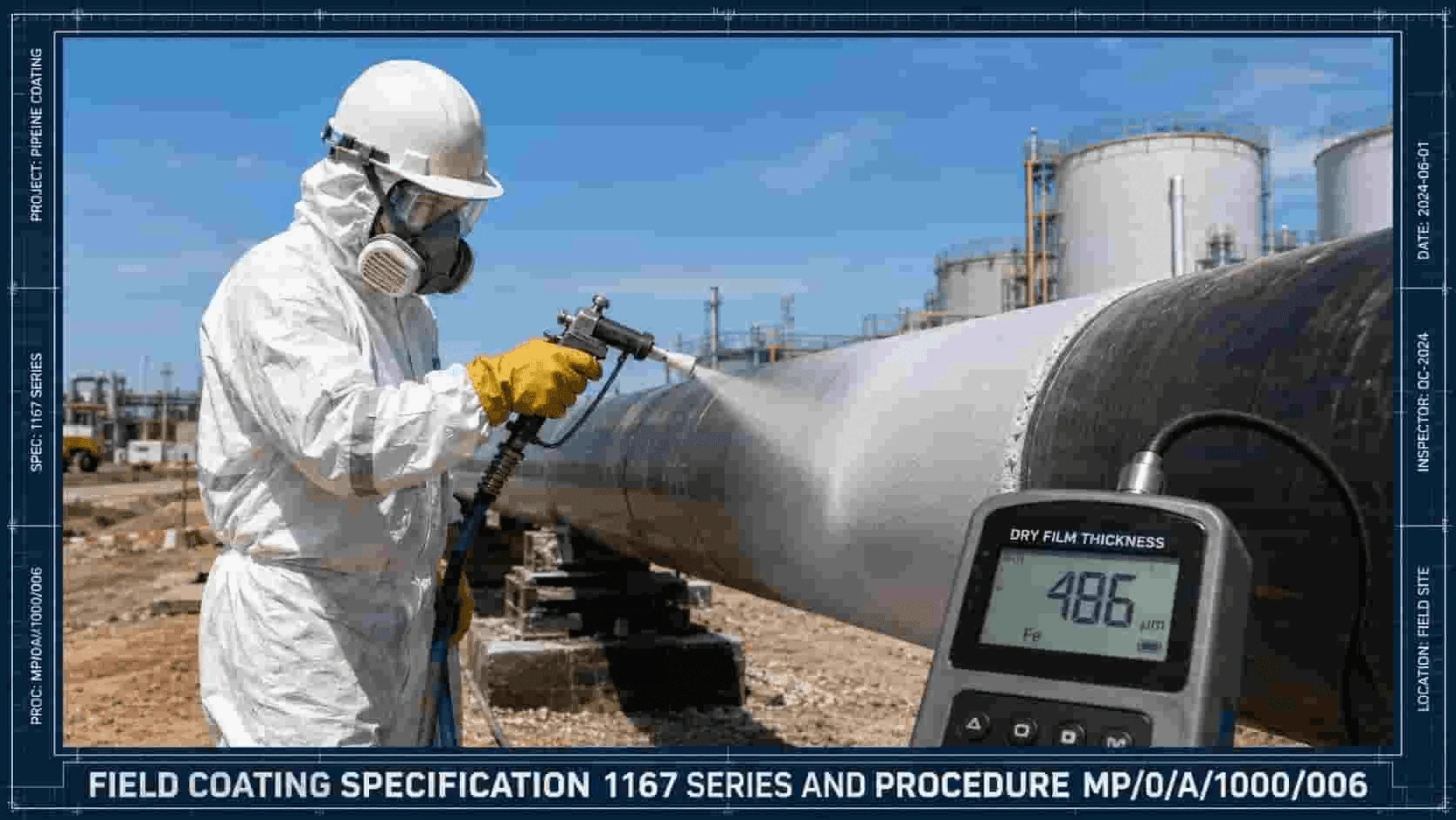
Industrial asset protection depends on precise coating specifications. The field coating specification 1167 series and procedure mp/0/a/1000/006 establishes the benchmark for applying high-performance protective coatings in demanding environments. This specification ensures that critical infrastructure—pipelines, storage tanks, and structural steel—receives consistent, verifiable protection against corrosion. Success depends on more than material selection; it requires rigorous adherence to defined surface preparation, application parameters, and quality control protocols. Facility engineers, coating inspectors, and project managers must master this specification to achieve the 20+ year service life that modern assets demand.
What the Field Coating Specification 1167 Series and Procedure MP/0/A/1000/006 Covers
This field coating specification is a comprehensive framework governing the complete coating lifecycle—from surface preparation through final inspection. It aligns with industry-recognized standards including SSPC-PA 1, the fundamental standard for shop, field, and maintenance coating of metals . The field coating specification 1167 series and procedure mp/0/a/1000/006 provides mandatory requirements for contractor execution and forms the basis for quality acceptance.
Understanding the full scope of this field coating specification is essential before project execution begins.
Scope and Application
The procedure applies to carbon steel substrates requiring high-performance protective systems. It covers both new construction coating and maintenance painting operations, establishing uniform requirements regardless of project location or environmental conditions. Field application scenarios include tank exteriors, pipeline segments, structural members, and equipment surfaces. When referenced in a contract, this field coating specification becomes legally binding—all sections are mandatory unless the contract explicitly notes exceptions .
Critical Surface Preparation Standards Under the Specification
Surface preparation determines coating system success more than any other factor. Premature coating failures—delamination, under-film corrosion, and blistering—almost always trace to inadequate surface preparation . The field coating specification 1167 series and procedure mp/0/a/1000/006 demands stringent cleanliness standards that require careful execution and verification.
Achieving the Required Near-White Metal Blast
The field coating specification requires SSPC-SP 10 / NACE No. 2 (near-white metal blast cleaning) for most high-performance applications. This standard demands removal of all visible mill scale, rust, coating, and foreign matter—leaving only slight staining, no more than 5% of the surface area . The anchor profile must measure 40 to 75 microns (2 to 3 mils) for most coating systems, verified using replica tape or Testex Press-O-Film tape according to ASTM D4417 .
Surface Contamination Limits and Testing
Surface cleanliness extends beyond visible contaminants. Soluble salts—chlorides, sulfates, and nitrates—pose significant adhesion risks even on visually clean surfaces. The field coating specification 1167 series and procedure mp/0/a/1000/006 sets salt contamination limits at 30 to 50 µg/cm² (NaCl equivalent) for most systems. Testing uses the Bresle patch method (ISO 8502-6 and ISO 8502-9). If tests indicate excessive contamination, additional washing or treatment becomes mandatory before coating proceeds .
Application Procedure MP/0/A/1000/006 Step-by-Step
Procedure MP/0/A/1000/006 outlines the precise execution sequence for field application. Following this procedure ensures consistent dry film thickness, proper cure, and defect-free coating that meets the field coating specification.
Environmental Conditions and Substrate Temperature
The procedure prohibits coating application when conditions compromise adhesion or cure. The substrate temperature must remain a minimum of 3°C above the dew point—measured with a psychrometer or digital hygrometer . Coating in high humidity or dropping temperatures risks moisture entrapment and premature failure. The field coating specification mandates monitoring and recording environmental conditions throughout application. When wind velocity negatively impacts coating application quality, work must cease—a change from the older 25 MPH absolute limit to a performance-based criterion .
Mixing, Induction, and Pot Life Management
Multi-component coating systems require precise material handling. The field coating specification 1167 series and procedure mp/0/a/1000/006 specifies mixing ratios, induction times, and pot life restrictions. For example, a 1:1 mix ratio coating may require 30 minutes induction at 50-60°F, reducing to 5 minutes above 90°F . Any thinner addition must follow manufacturer instructions, and for coatings requiring induction time, thinners are added only after the induction period elapses . Maintaining mixing logs and temperature records ensures batch traceability and compliance.
Spray Application Parameters and Equipment
Spray application requires equipment selection matched to coating viscosity and project scale. The field coating specification typically references plural component airless spray pumps with minimum ratios (e.g., 58:1 for high-viscosity materials). Spray tips range from .015 to .023 inch orifice, selected based on actual viscosity at application time . Operators must maintain perpendicular gun orientation, consistent distance, and proper overlap to achieve uniform wet film thickness. The specification prohibits building dry film thickness beyond recommended maximums in a single pass .
Stripe Coating Requirements for Complex Surfaces
Edges, corners, bolts, welds, and irregular surfaces demand extra attention. The procedure requires stripe coating these areas before full coat application—working coating material into crevices and hard-to-reach locations . For rough or pitted surfaces, this requirement is especially critical. Application methods include brush, roller, or dauber, ensuring all complex geometry receives adequate film thickness . The field coating specification mandates this as a non-negotiable step—failure to stripe coat creates weak points where corrosion initiates.
Quality Control and Inspection Requirements
Inspection validates that application complies with the field coating specification. The field coating specification 1167 series and procedure mp/0/a/1000/006 assigns responsibility to a Qualified Coating Inspector who documents all quality parameters .
Dry Film Thickness (DFT) Measurement
DFT measurement follows SSPC-PA 2 using a Type II fixed-probe gauge. The specification requires three readings per spot, averaged, with five spot measurements per test area. The average must fall within 80-120% of specified nominal thickness . Testing frequency escalates with surface area: three locations per first 1,000 square feet, then one additional location per each 1,000 square feet thereafter . Readings outside tolerance trigger corrective action—additional coats or repair—before the project advances.
Holiday Detection and Porosity Testing
Holidays—pinholes, voids, and discontinuities—compromise barrier protection. The field coating specification typically requires low-voltage or high-voltage holiday detection depending on coating thickness. ASTM G62 provides the reference method . All detected holidays receive marking and repair before final inspection. This step is particularly critical for immersion service coatings, where even microscopic discontinuities permit moisture penetration and under-film corrosion.
Cure Monitoring and Recoat Window Tracking
Cure time determines the recoat window—the period when subsequent coats achieve optimal intercoat adhesion. The field coating specification requires daily recoat window calculation based on ambient conditions and film thickness, using the highest recorded temperature to establish the window . The inspector maintains a log of application start/stop times and communicates recoat windows to the Project Manager. If the recoat window passes without application, surface preparation requirements may reset.
Common Challenges in Field Application
Even with a robust field coating specification, field execution faces obstacles that require proactive management.
Environmental Constraints and Scheduling
Weather impacts both application quality and schedule. Rain, high humidity, and wind force work stoppages. The field coating specification 1167 series and procedure mp/0/a/1000/006 enables inspectors to pause work when conditions fail to meet requirements. Effective scheduling—performing application during optimal conditions and protecting completed areas from recontamination—minimizes delays.
Achieving Uniform Thickness on Complex Geometry
Reaching specified DFT on edges, flanges, and structural profiles demands operator skill. These areas typically receive stripe coats and additional passes. The inspector must verify that DFT on complex geometry meets the same minimums as flat surfaces. Using wet film thickness gauges during application enables real-time adjustment—thicker or thinner passes correct film build before drying.
Material Handling and Pot Life on Large Projects
Large-scale projects consume coating faster than smaller jobs, demanding efficient logistics. Pot life (typically 45-90 minutes at 75°F) limits batch size—mixing larger quantities than can be applied wastes material and risks premature gelation . The field coating specification requires pre-job planning to optimize batch sizing and minimize waste.
Conclusion
The field coating specification 1167 series and procedure mp/0/a/1000/006 represents the industry benchmark for industrial coating application. Mastering its requirements—surface preparation to near-white metal, precise application parameters, and thorough quality control—directly delivers extended asset life and minimized maintenance costs. Every step, from blast cleanliness to cure-time tracking, protects the multimillion-dollar investment in industrial infrastructure. Following this field coating specification creates a verifiable record of quality, providing confidence that each asset receives protection matching its service demands.
Frequently Asked Questions
Q1: What does field coating specification 1167 series and procedure mp/0/a/1000/006 require for surface preparation?
This field coating specification mandates near-white metal blast cleaning (SSPC-SP 10) for most high-performance applications. The anchor profile must measure 40–75 microns, verified with replica tape. Soluble salt contamination must fall below 30–50 µg/cm² measured by the Bresle patch method. These strict requirements ensure coating adhesion and service life. The surface must also be free of grease, oil, dust, and moisture before coating application begins.
Q2: How is dry film thickness (DFT) measured and verified under this field coating specification?
DFT measurement follows SSPC-PA 2 using a Type II fixed-probe gauge. The field coating specification requires three readings per test spot, averaged, with five spots per test area. The overall average must stay within 80–120% of the specified nominal thickness. Test frequency increases with surface area. Readings outside tolerance trigger corrective action. All measurements are documented in the inspection report.
Q3: What environmental conditions does procedure MP/0/A/1000/006 permit for coating application?
The procedure requires substrate temperature to be at least 3°C above the dew point. Relative humidity must remain below 85% in most cases. Application ceases when wind negatively impacts coating quality—the old 25 MPH absolute limit is replaced with a performance-based criterion. Wet or contaminated surfaces are never coated. Environmental monitoring occurs throughout application, with detailed records maintained for quality assurance.
Q4: Why is stripe coating mandatory in the field coating specification?
Stripe coating ensures edges, corners, bolts, welds, and rough surfaces receive adequate film thickness. These areas experience accelerated corrosion if under-coated. The specification requires stripe coating before full coat application, working coating material into all crevices and irregularities. Brush, roller, or dauber application methods are acceptable for stripe coating. This non-negotiable step extends coating system service life in vulnerable locations.
Q5: How does the field coating specification address recoat windows?
Recoat windows are calculated daily based on ambient conditions and applied film thickness. The inspector uses the highest recorded temperature to establish the window. Recoat window tracking ensures optimum intercoat adhesion—applying too early or too late risks delamination. A detailed log of application start/stop times and cure conditions documents compliance. If the recoat window is missed, surface preparation may need to be repeated before recoating.
Q6: Which industry standards support the field coating specification 1167 series?
Key referenced standards include SSPC-PA 1 (shop, field, and maintenance coating of metals), SSPC-SP 10 (near-white metal blast cleaning), SSPC-PA 2 (DFT measurement), ASTM D4417 (anchor profile), and ASTM G62 (holiday detection). ISO 8501-1 (surface preparation visual assessment) and ISO 1167 (thermoplastics pipe testing) may also apply depending on the substrate . The 2024 version of SSPC-PA 1 introduced significant changes, including updated holiday