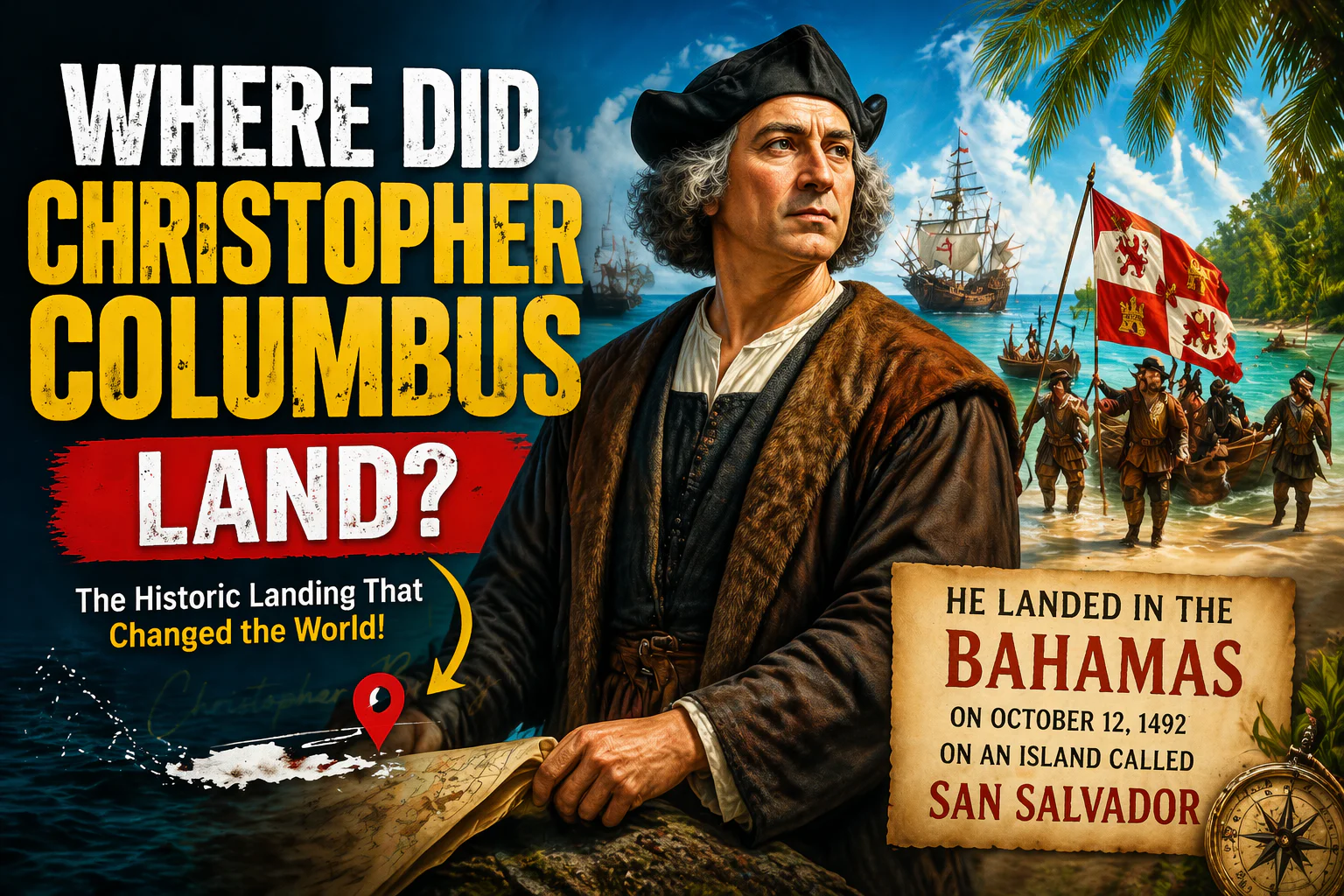
where did christopher columbus land
Have you ever wondered exactly where did Christopher Columbus land when he crossed the ocean blue? Many people imagine the mainland United States, but that is not correct. The truth is far more fascinating and involves tiny islands, brave sailors, and a complete surprise for everyone in Europe. Understanding this moment helps us see how our modern world began. In this guide, we will sail back to 1492. We will follow the three famous ships. You will learn the exact spot where history changed forever. Get ready for a clear, simple, and exciting journey into the past.
Table of Contents
| # | Heading Title | Short Description (What You’ll Learn) |
|---|---|---|
| 1 | The Big Question: His First Landing Spot | Direct answer to where Columbus first stepped foot and why it’s not the US mainland. |
| 2 | Setting Sail: Why Did Columbus Go West? | The real reason Spain funded the risky voyage across the Atlantic Ocean. |
| 3 | Land Ho! The Night That Changed Everything | The dramatic moment land was sighted and the morning landing ceremony. |
| 4 | So, Where Did Christopher Columbus Land Exactly? | Exact coordinates, modern name, and the debate among historians. |
| 5 | Welcome to San Salvador: The Island’s Real Name | Description of the island then and now, plus its original Taino name. |
| 6 | First Meetings: The Kind and Curious Taino People | Who were the native inhabitants? Their culture and tragic fate. |
| 7 | The Three Ships: Niña, Pinta, and Santa Maria | Details of each vessel and what happened to the Santa Maria. |
| 8 | Did He Know He Found a New World? | Columbus’s lifelong belief about reaching Asia (and why he was wrong). |
| 9 | The Second and Third Voyages: Exploring More Lands | Where he went next, including Jamaica, Puerto Rico, and South America. |
| 10 | Why His Landing Still Matters Today | The Columbian Exchange and how it changed food and history forever. |
| 11 | Fun Comparison: Columbus vs. Christopher Walken | A lighthearted look at the explorer versus the famous actor. |
| 12 | The Truth About the Native People | The harsh realities of slavery, disease, and population decline. |
| 13 | Mapping the Route: Can You Visit the Landing Site? | Travel info about San Salvador Island and the monument there. |
| 14 | Common Myths About the First Landing | Debunking myths like “proving Earth is round” and “first in America”. |
| 15 | How Historians Know the Truth Today | Evidence from Columbus’s diary, archaeology, and ocean currents. |
| 16 | Final Thoughts on This Historic Moment | Balanced reflection on bravery, consequences, and shared history. |
| 17 | FAQs (6 Questions) | Quick answers to common questions about the landing location. |
| 18 | Conclusion: A Journey Worth Remembering | Encouragement to explore more and share historical knowledge. |
The Big Question: His First Landing Spot
For hundreds of years, schoolchildren have asked the same simple question: where did Christopher Columbus land on his famous trip? The answer is not a large country like America. It is a small, beautiful island in the Bahamas. On October 12, 1492, after more than two months at sea, a lookout named Rodrigo de Triana saw land. That moment ended a long and scary journey. Columbus believed he had reached Asia. He called the people he met “Indians.” But in truth, he had stepped onto a continent that Europe did not know existed.
Setting Sail: Why Did Columbus Go West?
To understand where did Christopher Columbus land, you must first know why he left Spain. Columbus wanted a new trade route to Asia. At that time, Europeans traveled east to get spices and silk. The journey was long and dangerous. Columbus had a bold idea. He thought the world was round and small. He believed he could sail west to reach China and Japan faster. King Ferdinand and Queen Isabella of Spain gave him money and three ships. So, in August 1492, he left with 90 men, hoping to find gold and glory.
Land Ho! The Night That Changed Everything
The night of October 11, 1492, was tense for everyone on board. The sailors were tired and scared. They had not seen land for many weeks. Then, at two in the morning, a cannon fired. It was the signal for land. Rodrigo de Triana had seen a white cliff in the moonlight. Columbus later claimed he saw a light earlier that night. The next morning, they rowed to shore. This moment answers the question of where did Christopher Columbus land for the first time. He stepped onto a sandy beach, planted a cross, and named the island San Salvador.
So, Where Did Christopher Columbus Land Exactly?
Now, let us give you the clear, factual answer. Where did Christopher Columbus land on October 12, 1492? He landed on an island in the Bahamas called Guanahani by the native people. Columbus renamed it San Salvador, which means “Holy Savior.” For many years, historians argued over which island was the real Guanahani. Today, most experts agree it is what we now call San Salvador Island, also known as Watling Island. It is a small piece of land about 200 miles southeast of Miami, Florida. This spot is the very beginning of European contact with the Americas.
Welcome to San Salvador: The Island’s Real Name
San Salvador is a quiet, sunny island today. It has beautiful blue water and sandy beaches. But back in 1492, it was covered with trees and plants. The native Taino people lived there in peaceful villages. They grew corn, cotton, and sweet potatoes. When Columbus arrived, the Taino people came to the beach to see the strange ships. They were friendly and curious. They gave the Spanish parrots, cotton thread, and spears. Columbus wrote in his diary that the people were kind and generous. He did not know that this meeting would lead to terrible changes for them.
First Meetings: The Kind and Curious Taino People
When you learn where did Christopher Columbus land, you must also learn about the people he met. The Taino were not simple or stupid. They had their own language, religion, and government. They lived in large huts and made beautiful pottery. Columbus was impressed by their gold earrings. He immediately asked where the gold came from. The Taino pointed south to a larger island. Columbus took several Taino people as prisoners to show the king and queen of Spain. Sadly, this was the start of slavery, disease, and war that destroyed the Taino culture within a few decades.
The Three Ships: Niña, Pinta, and Santa Maria
Let us talk about the ships that carried Columbus to his landing site. The Santa Maria was the largest ship. It was a heavy cargo ship that moved slowly. The Niña and the Pinta were smaller, faster caravels. They could sail in shallow water near islands. On Christmas Eve of 1492, the Santa Maria ran aground on a reef near Haiti. The crew had to leave it behind. They used the wood to build a small fort called La Navidad. This is another piece of the puzzle for where did Christopher Columbus land. The Pinta and Niña returned to Spain with the good news in early 1493.
Did He Know He Found a New World?
Here is a surprising fact. Even after landing, Columbus never admitted he found a new continent. He died in 1506 still believing he had reached Asia. He called the lands the “Indies” and the people “Indians.” He thought Cuba was China and Hispaniola was Japan. This mistake is why we use the word “Indians” for Native Americans. So, when you ask where did Christopher Columbus land, remember that he did not know the truth. Another explorer named Amerigo Vespucci later realized these lands were a “New World.” That is why America is named after Vespucci, not Columbus.
The Second and Third Voyages: Exploring More Lands
Columbus made four trips in total. On his second voyage in 1493, he returned with 17 ships and 1,200 men. He wanted to find more gold and take control of the islands. He explored places like Jamaica, Puerto Rico, and the Virgin Islands. On his third voyage in 1498, he finally reached the mainland of South America. He saw the coast of modern-day Venezuela. Still, he did not know it was a new continent. So, when people ask where did Christopher Columbus land on later trips, the answer is many Caribbean islands and parts of Central and South America.
Why His Landing Still Matters Today
The question of where did Christopher Columbus land is not just about geography. It is about the start of a connected world. After 1492, Europe, Africa, and the Americas began to trade goods, plants, animals, and sadly, diseases. This exchange is called the Columbian Exchange. It brought horses, wheat, and sugar to the Americas. It brought corn, potatoes, and tomatoes to Europe. These foods changed how people ate forever. For example, Italian food without tomatoes was common before 1492. Irish food without potatoes was also normal. Columbus’s landing changed dinner tables around the globe.
Fun Comparison: Christopher Columbus vs. Christopher Walken
Sometimes, people confuse the name Christopher Columbus with the famous actor Christopher Walken. But they are very different. Columbus was an explorer from Italy who lived 500 years ago. Christopher Walken is a living American actor known for his unique voice and dance moves. Walken starred in movies like “The Deer Hunter” and “Hairspray.” While Columbus landed on beaches in the Bahamas, Christopher Walken lands on red carpets in Hollywood. One changed history with a ship; the other entertains us on screen. So, if you search “where did Christopher Columbus land,” do not expect to find a movie star.
The Truth About the Native People
We must tell the whole story about the landing. Columbus was a great sailor, but he was also a harsh governor. He forced the Taino people to find gold. If they did not bring enough gold, their hands were cut off. Many Taino died from hard work and European diseases like smallpox. Within 30 years of his landing, the population of Taino fell from perhaps 300,000 to just a few thousand. Modern historians and Native American groups have worked to share this painful truth. Today, many people celebrate Indigenous Peoples’ Day instead of Columbus Day to honor the first Americans.
Mapping the Route: Can You Visit the Landing Site?
Yes, you can visit the place where did Christopher Columbus land. San Salvador Island is part of the country of the Bahamas. It is a quiet place for diving, fishing, and history. There is a large cross monument at the landing site called Columbus Beach. The government protects this area as a national landmark. You can also see the ruins of the Santa Maria’s camp in Haiti. However, the fort La Navidad was destroyed by the Taino after Columbus left. Visiting these places helps you feel the weight of history. You can walk on the same sand where Columbus walked in 1492.
Common Myths About the First Landing
Many myths surround this famous event. First, Columbus did not prove the Earth was round. Educated people in 1492 already knew the Earth was a sphere. Second, he never set foot on the mainland of North America. That happened on later voyages by other explorers. Third, he did not discover America alone. Leif Erikson, a Viking, landed in Canada around the year 1000. Finally, the idea that Columbus was the only smart one is wrong. The Taino people had navigated the Caribbean for centuries. They knew where did Christopher Columbus land long before he arrived—it was their home.
How Historians Know the Truth Today
How do we know so much about the landing? We have Columbus’s own diary. A priest named Bartolomé de las Casas copied parts of it. We also have letters Columbus wrote to the king and queen. Scientists have studied old maps and used modern technology to track ocean currents. They have also done underwater archaeology near the Bahamas. They found anchors and pots that match the time period. This mix of history and science gives us a clear answer. So, when you ask where did Christopher Columbus land, the evidence points firmly to San Salvador in the Bahamas.
Final Thoughts on This Historic Moment
Understanding this event helps us understand our shared human story. One small landing on a tiny island connected two halves of the world. It brought both good things and terrible things. Today, we can look back with open eyes. We can celebrate the bravery of sailing into the unknown. We can also honor the Taino people who lost their world. The best history does not hide the hard parts. It tells the whole truth. Now you know the real answer to where did Christopher Columbus land. Share this knowledge with a friend or a child. Keep the conversation going.
Frequently Asked Questions (FAQs)
Q1: Where did Christopher Columbus land on his first voyage?
A: He landed on an island in the Bahamas called Guanahani. He renamed it San Salvador. This happened on October 12, 1492. The island is about 200 miles southeast of Miami.
Q2: Did Columbus ever land in the United States?
A: No, he did not. He explored the Bahamas, Cuba, Haiti, the Dominican Republic, Jamaica, and Puerto Rico. He also reached South America on his third voyage. The mainland United States was explored by later Spanish and English settlers.
Q3: Why is the landing location important?
A: It started the Columbian Exchange. This was a huge movement of plants, animals, people, and diseases between the Eastern and Western Hemispheres. It changed food, culture, and population all around the world forever.
Q4: Are there monuments at the landing site?
A: Yes. On San Salvador Island, there is a large stone cross and a plaque. The local government protects the beach as a historical landmark. Tourists can visit and take photos at the exact spot.
Q5: How do we know where he landed?
A: We have Columbus’s diary, old maps, and letters. Scientists have studied ocean currents and found old ship artifacts. Most historians agree San Salvador is the correct location based on all this evidence.
Q6: What happened to the Taino people after Columbus arrived?
A: Sadly, many Taino died from disease, war, and forced labor. The Spanish took them as slaves to find gold. Within 30 years, their population dropped from hundreds of thousands to only a few thousand people.
Conclusion: A Journey Worth Remembering
Now you have the full answer to the question: where did Christopher Columbus land? You know it was a small, beautiful island in the Bahamas called San Salvador. You understand the bravery and the mistakes of that voyage. You also learned about the Taino people who were there first. History is not just about dates and names. It is about people, choices, and consequences. We invite you to learn more. Read a book about the Columbian Exchange. Visit a museum about Native American history. Or simply share this article with someone who loves history. Every time we ask good questions, we become better thinkers. Keep exploring the past to understand the present.
About the Author


